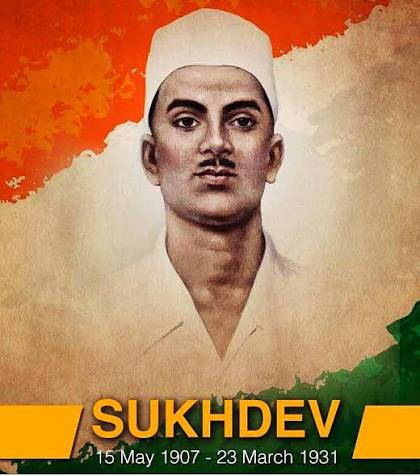
Sukhdev
& Bhagat Singh
Two people, the same college, the same organisation, the same scaffold. Set them side by side and the “friend of Bhagat Singh” framing collapses on contact with the record.
Born at Ludhiana
15 May 1907, to Ramlal Thapar and Ralli Devi. Raised substantially in the household of his uncle Lala Achint Ram, a nationalist worker.Born at Banga
28 September 1907, in the Lyallpur district of Punjab, into a family already deeply involved in nationalist and Ghadar-connected politics.Student, and organiser of the reading
Enters National College, Lahore. Described across memoirs as one of the organisers of the political study circles that ran alongside the curriculum.Student, and the college’s public voice
Enters the same college, having left government-recognised education during Non-Cooperation. Begins writing and speaking — the skill that would define his public role.Organiser
Among the organisers of the Naujawan Bharat Sabha at Lahore. Recruitment, vetting and political education across the towns of Punjab.Propagandist
Co-organiser of the same body, working chiefly on its public argument — meetings, journalism and the written case for a secular, socialist independence.Takes the Punjab
Attends the reorganisation meeting as a Punjab representative and assumes responsibility for the HSRA’s work in the province.1928Feroz Shah Kotla
Argues the programme
Among those pressing for the explicit socialist commitment that produced the organisation’s new name.Planning
Recorded among those who planned the action taken in response to the death of Lala Lajpat Rai. He did not fire, and was not present at the shooting.1928Saunders
Execution of the plan
One of the two men who fired on J. P. Saunders outside the District Police Lines, Lahore. Escapes the city in disguise days later.Not present
Sukhdev took no part in the Central Legislative Assembly action and was not in Delhi. He remained in Punjab, running the organisation there.1929The Assembly
Arrest by design
With Batukeshwar Dutt, throws two bombs into an empty section of the Assembly chamber and scatters leaflets. Neither man attempts to escape.Arrested at Lahore
Taken in the wave of arrests that followed the discovery of HSRA bomb-making premises. Charged in the conspiracy case.1929Arrests
Already in custody
Held after the Assembly action, then brought into the Lahore conspiracy proceedings as the investigation traced the organisation back to Punjab.On strike
Among the accused who hunger-struck for recognition as political prisoners rather than ordinary convicts.On strike
Among those who began the strike in June 1929. The death of Jatindra Nath Das on 13 September made it a national issue.Sentenced to death
By the Special Tribunal constituted under the ordinance of 1 May 1930.1930Judgment
Sentenced to death
By the same tribunal, in the same judgment, on the same charge of conspiracy.Executed, aged 23
Lahore Central Jail, evening of 23 March 1931.1931Execution
Executed, aged 23
Lahore Central Jail, the same evening, with Rajguru.Two Functions, Not a Leader and a Follower
Read down the two columns and a pattern appears that the “friend” framing hides entirely. These are not a principal and an assistant. They are two different jobs inside one organisation.
Bhagat Singh was the movement’s public argument. He wrote, he spoke, he was photogenic in the specific way that political martyrdom requires, and he understood better than anyone around him how to use a courtroom as a printing press. When the HSRA needed someone to be seen, it sent him.
Sukhdev was the movement’s continuity. He found people, tested them, taught them, and held a provincial structure together while others travelled and were arrested. When the HSRA needed something to still exist next month, it relied on him.
Neither function is subordinate to the other. But only one of them generates famous photographs, and history is written from the surviving material.
What they left behind, in writing
The asymmetry in the record is stark and largely explains the asymmetry in fame. Bhagat Singh wrote prolifically — journalism, jail notebooks, and the 1930 essay Why I Am an Atheist, written in Lahore jail while under sentence. Sukhdev left very little. The principal text attributed to him is a single letter addressed to Mahatma Gandhi, published after his execution.
A man who writes leaves a historian something to work with. A man who organises leaves an absence.
What the Record Does Not Support
Separating the documented association from a century of dramatisation.
That they were fellow students at National College; co-organisers of the Naujawan Bharat Sabha; members of the same clandestine organisation; co-accused in the same case; sentenced in the same judgment; and executed on the same evening.
That Sukhdev pressed for Bhagat Singh to be the one to carry out the Assembly action, reversing an earlier decision of the organisation. This is described in memoirs written long afterwards by surviving comrades. It is well attested but not contemporaneously documented, and the tellings differ.
Verbatim private conversations between them. Reconstructed emotional motives. Rivalry, jealousy or resentment as an explanation of their conduct. Deathbed exchanges. None of this rests on documentary evidence, however confidently it is repeated in popular retellings and on screen.
The mythologising is understandable and it is not harmless. Dramatised versions of this friendship — in film, in school retellings, in circulated quotations — have supplied private dialogue, interior feeling and personal rivalry that no source records. Because those inventions are vivid and the documentary record is dry, the inventions travel further.
The practical consequence for Sukhdev is specific. Fiction needs a protagonist and a supporting character, so it casts him as the second. The historical record, which has no such requirement, shows two people doing different and equally necessary work.
This archive quotes no conversation between them, reproduces no attributed dialogue, and reconstructs no private scene. Where a text exists — a letter, a statement, a court record — it is named. Where it does not, nothing is supplied in its place.